About
I work at the seam between analytics, AI and product, taking the operational data a business already has and turning it into something someone can act on before lunch.
That started in a university lab, where my team built an Indian Sign Language recognition system from nothing: no usable dataset existed, so we created one, trained a convolutional network on it, and the underlying method was granted an Indian patent in 2025.
Since then I've been building AI-native operational tooling: a farm-intelligence cockpit for a controlled-environment agriculture operator, and a coverage-intelligence layer for an entertainment PR agency. Both started the same way, by sitting with the people doing the work, finding the hours being lost to manual reporting, and building the thing that gives those hours back.
I'm currently deepening my work in agent architecture, designing AI systems that hold context, verify their own output, and behave like a dependable colleague rather than a clever demo.
Work
-
Live prototype
AGRIA · Farm Intelligence Cockpit
Controlled-environment agriculture operator · Gulf region
Yield, cost and water tracked against plan across three growing facilities, with live sensor alerts, optimal-band (“Goldilocks”) monitoring per environmental parameter, and an investor report that compiles itself from the same feed driving the cockpit, replacing the slide-building that used to happen before every update call.
- 5–7 hrs/week → 35 min reporting cycle
- 2-quarter payback modelled on automation capex
- 8% budget overrun caught by an automated valve alert
-
Live prototype
MEDIO PR · Coverage Intelligence Layer
Entertainment PR agency · Saudi market
An AI-native layer that turns “35 pieces of coverage” into reach, sentiment and share of voice against a named competitive set. Includes an always-on content calendar with drafts held for review, a press and influencer matcher that ranks contacts by beat fit rather than blasting a list, and a case-study generator that documents client wins.
- 142 contacts tagged by beat, market and language
- 78% positive/neutral sentiment split modelled
- Hit count → outcome score as the reporting unit
-
Open dataset
Indian Sign Language Dataset
Published open-source · Apache-2.0
No usable ISL dataset existed when the project began, so I built one. 12,700 images across all 26 alphabet classes, deliberately varied in background, lighting, colour and orientation, and including left-handed signing, which comparable datasets omit. Standardised, augmented, split 80/20 and shipped with train/test CSVs so anyone can pick it up.
- 12,700 images across 26 classes
- ~486 per class, processed and augmented
- Apache-2.0, publicly reusable
-
IBM SUR Grant Research
ISL Recognition with Deep Learning
B.Tech thesis · Cummins College of Engineering for Women, Pune
A convolutional network built from scratch rather than fine-tuned, then benchmarked honestly against three transfer-learning baselines. The custom CNN was selected for the accuracy-to-cost trade-off: near-identical accuracy at roughly a fifth of the training time, on a dataset too small for the heavier architectures to generalise.
- Shared University Research Grant, IBM awarded to the project
- Patented method, Indian Patent 569359
Model accuracy comparison Model Test acc. Train time Note Custom CNN 97.8% 2.4 min Selected · F1 0.98 VGG19 99.2% 11.9 min Marginal gain, 5× cost ResNet 81.1% n/a Needs a far larger dataset InceptionV3 76.8% ~45 min High variance, overfit
Research & Patent
Granted patent · Intellectual Property India
System for Translating Indian Sign Language into a Common Language and a Method Therefore
- Patent no.
- 569359
- Application
- 202021039523
- Filed
- 12 Sep 2020
- Granted
- 30 Jul 2025
Named inventor, alongside four co-inventors. Patentee: MKSSS’s Cummins College of Engineering for Women. The patent covers the recognition-and-translation method behind the dataset and CNN work above. The wider project was also awarded a Shared University Research Grant from IBM.
View certificate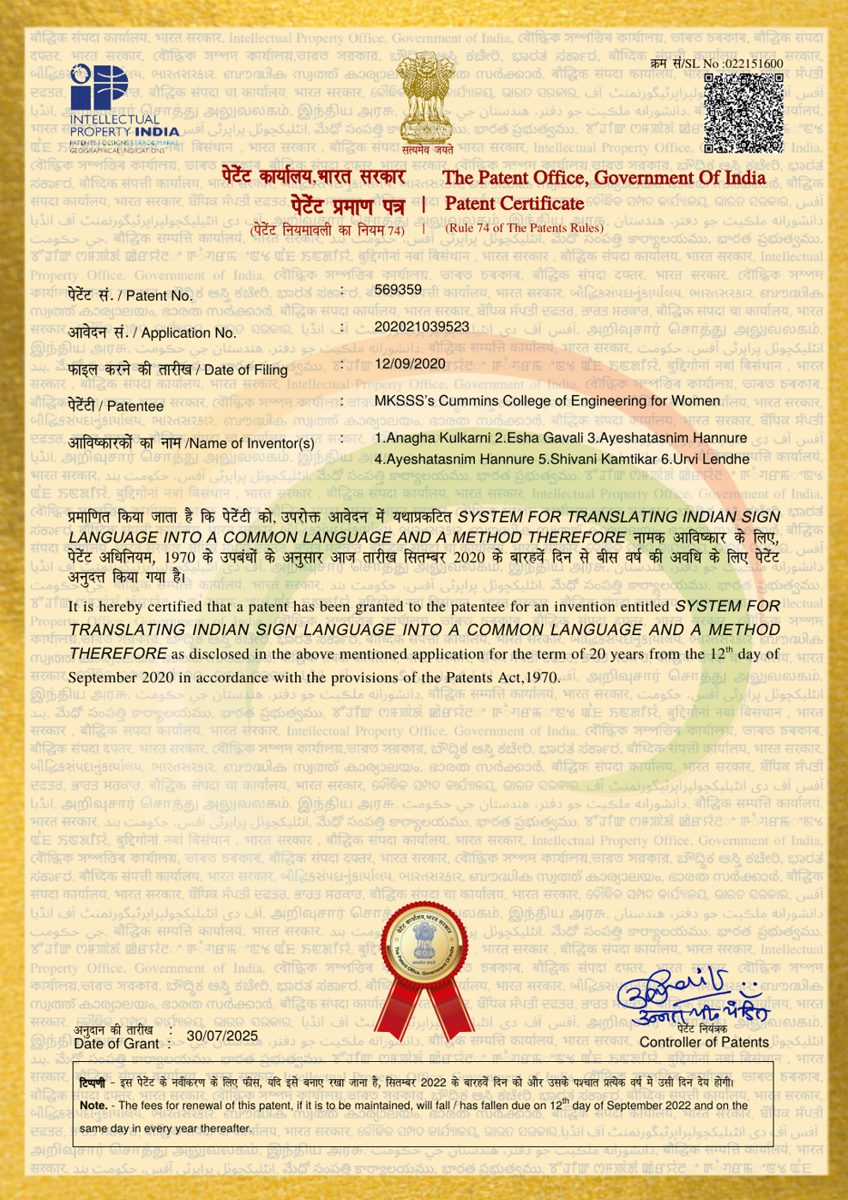
Skills
Analytics & Data
AI & Machine Learning
Product
Tools
Contact
Let’s talk
I’m open to roles and collaborations across analytics, AI and product. The fastest way to reach me is email - I read everything.
No mail app configured? Use “Copy address”.